Window to the Posterior Fossa
The mastoid fontanelle provides additional information on the structures of the posterior fossa. It is easily taught and applied, doesn’t extend the length of the examination and has a high diagnostic yield. The mastoid fontanelle is an intregal part of our routine cranial ultrasound series.
Limitations of imaging the posterior fossa via the anterior fontanelle include
1. Depth of structures relative to the anterior fontanelle -penetration issues
2. Focal Zone – structures not in optimal focal zones -?detail
3. Lack of emphasis of posterior fossa structure in cranial U/S education
The mastoid fontanelle is located above the mastoid tip, behind the ear. The fontanelle is created by the parietal, occipital and temporal bones and is generally closed by 6 mths of post term . Scanning is performed in 2 planes, axial and coronal. The axial plane is a plane through the superior orbital margin to the external auditory meatus. The coronal plane is a true coronal plane through the mastoid fontanelle.
There is a wide range of ultrasonically detectable pathology in the posterior fossa, which potentially could be missed due to limitations of imaging the posterior fossa well. These would include,
1. Congenital Abnormalities –Dandy Walker malformation, arachnoid cyst
2. Cerebellar Pathology- Cerebellar haemorrhage, atrophy
3. Posterior Fossa Tumours- Medullablastoma
4. Pathology of the CSF pathways – Stenosis of Aqueduct of Sylvius, cistern haemorrhage
Further reading AWindowToThePosteriorFossaTheMastoidFontanelle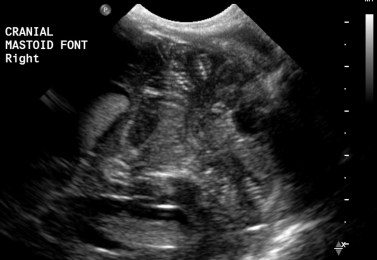
- Posted in: Links to Ultrasound related sites
 Pediatric Ultrasound A Practical Guide
You must be logged in to post a comment.